Remembering Marge Williams
“Well, hello there!”
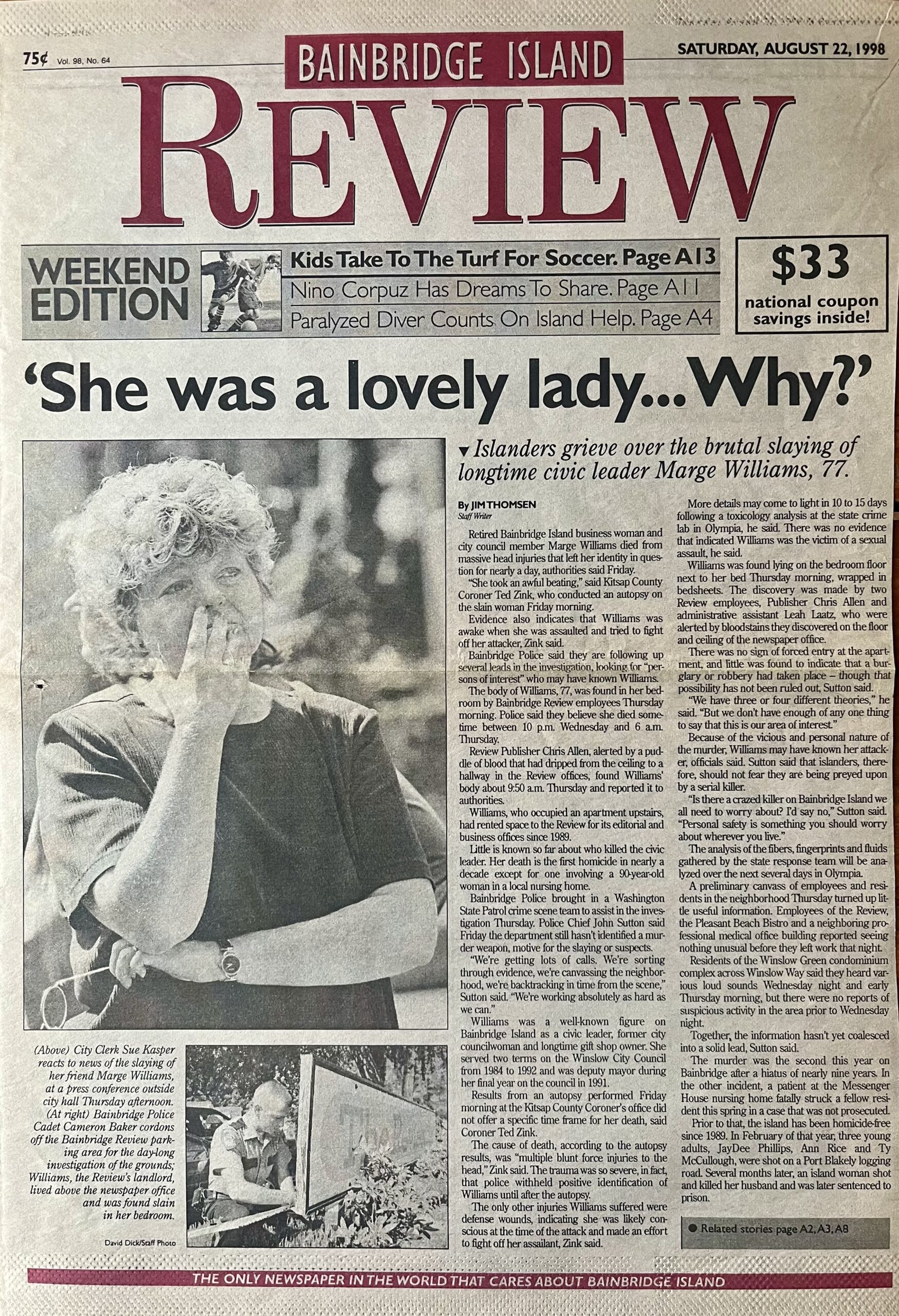
With that warm and heartfelt greeting, Marge Williams always had a way of making you feel welcome in the world. It didn’t matter if she’d just talked to you the day before. If you were Marge’s friend – and anyone who wasn’t, simply hadn’t made her acquaintance yet – the longtime island booster was always genuinely glad to see you.
“Hello there!” she would exclaim, two simple words infused with the depth of her sincerity and well-wishes.
Originally from Hawley, Minn., Marjory Wyland Williams moved to Bainbridge Island in 1957 and become a popular fixture in local civic affairs.
She and her husband ran a small gift shop from the downstairs of the building at 221 Winslow Way West. After her husband passed away, she resided in the apartment above the gift shop, retiring in 1989 to community service and occasional travel abroad.
Marge remained a well-known figure around town, and became landlord to the Bainbridge Island Review newspaper when it moved into the downstairs space below her apartment.
She was a tireless community booster with what was then known as Team Winslow, the island’s downtown organization, and put together the town’s first commemorative brick program as a community fundraiser. She was also elected to local office, serving on the Winslow town council from 1984 until all-island incorporation in 1991. She also helped found the Bainbridge Island Senior Community Center.
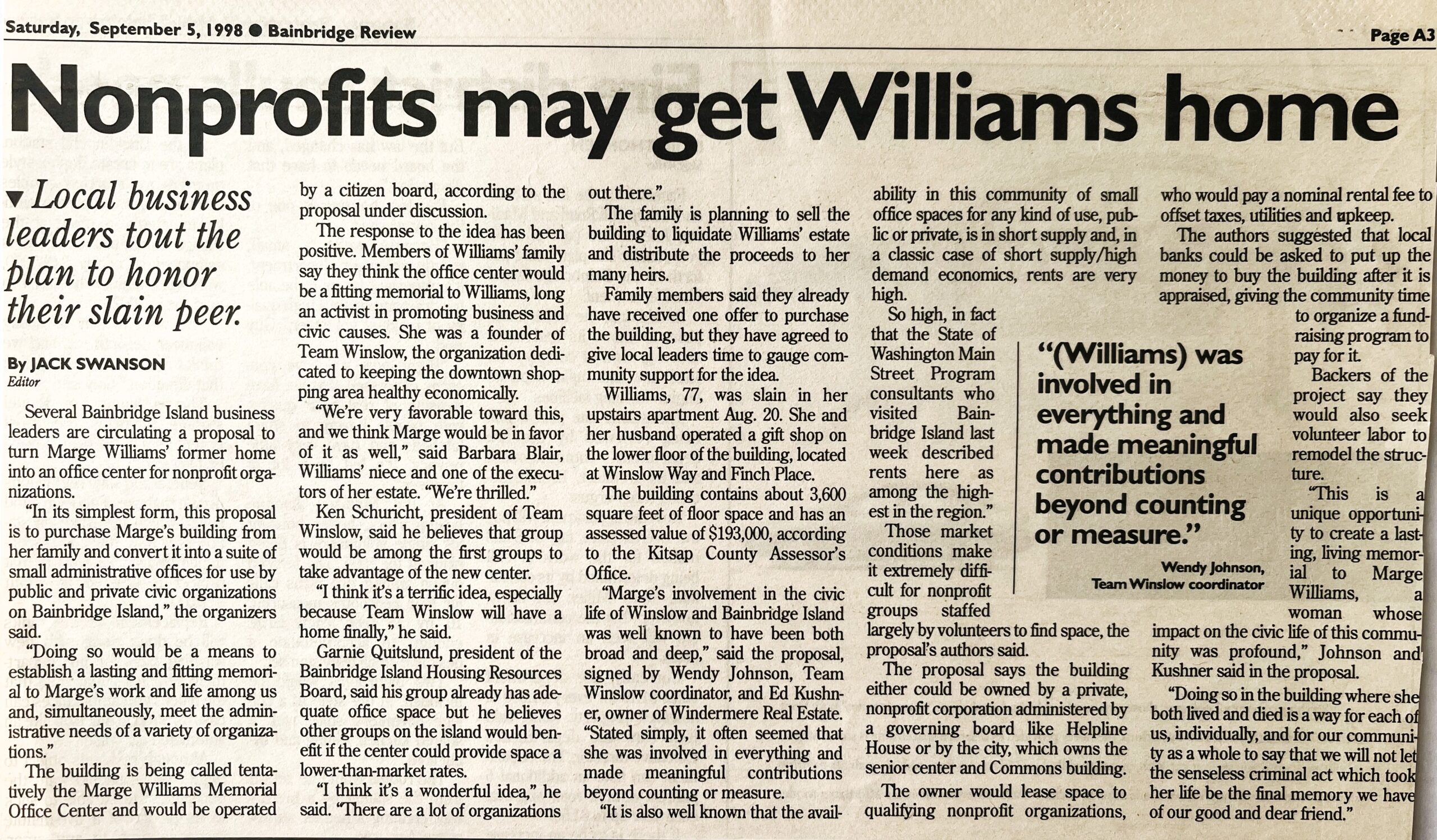
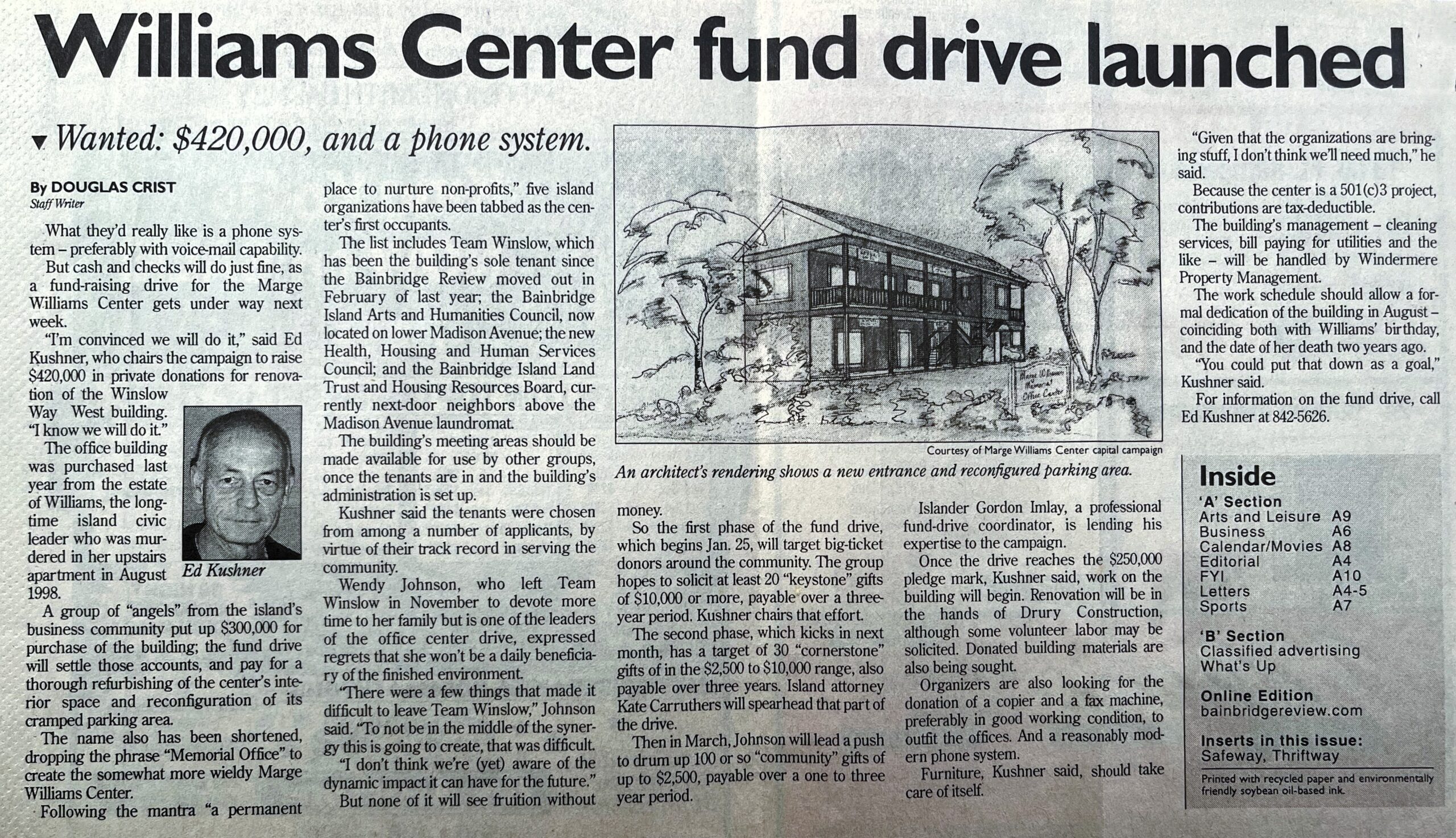
After her tragic death in August 1998, the island community that she had loved and served for so long rallied in her memory. A community fund drive raised more than $400,000 to purchase the Winslow Way building from the Williams estate and renovate it as a home for local nonprofit organizations.
The Marge Williams Center was formally dedicated in 2001, and the Washington State Office of Trade and Economic Development honored the center for Excellence in Downtown Revitalization the following year.
In 2016, to mark the center’s 15th anniversary, the Marge Center completed an extensive renovation with technology and conference room upgrades, a modern and efficient HVAC system, and an 8.9kW rooftop solar array to promote energy self-sufficiency.
The center stands as a lasting tribute to Marge Williams and her many contributions to the Bainbridge Island community.
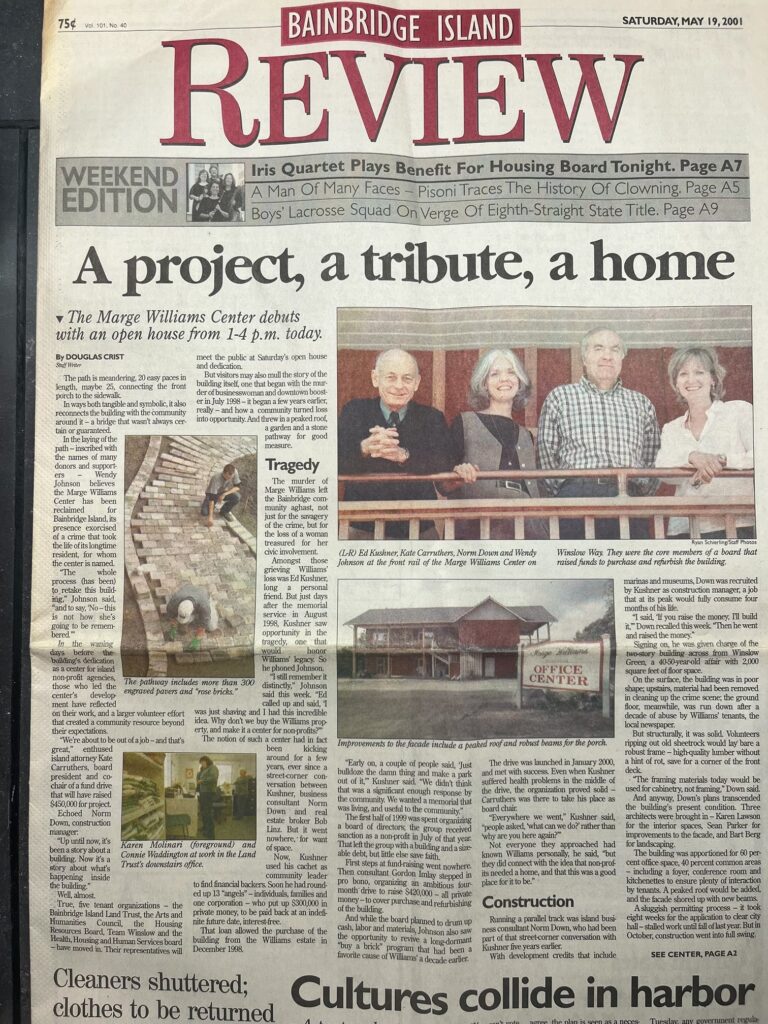
A project, a tribute, a home
The Marge Williams Center debuts with an open house from 1-4 p.m. today
Bainbridge Island Review, May 19, 2001
The path is meandering, 20 easy paces in length, maybe 25, connecting the front porch to the sidewalk.
In ways both tangible and symbolic, it also reconnects the building with the community around it – a bridge that wasn’t always certain or guaranteed.
In the laying of the path – inscribed with the names of many donors and supporters – Wendy Johnson believes the Marge Williams Center has been reclaimed for Bainbridge Island, its presence exorcised of a crime that took the life of its longtime resident, for whom the center is named.
“The whole process has been to retake this building,” Johnson said, “and to say, ‘No – this is not how she’s going to be remembered.”
In the waning days before the building’s dedication as a center for island non-profit agencies, those who led the center’s development have reflected on their work, and a larger volunteer effort that created a community resource beyond their expectations.
“We’re about to be out of a job – and that’s great,” enthused island attorney Kate Carruthers, board president and co-chair of a fund drive that is nearing $450,000 raised for the project.
Echoed Norm Down, construction manager: “Up until now, it’s been a story about a building. Now it’s a story about what’s happening inside the building.”
Well, almost. True, five tenant organizations – the Bainbridge Island Land Trust, the Arts and Humanities Council, the Housing Resources Board, Team Winslow and the Health, Housing and Human Services board – have moved in. They will greet the public at Saturday’s open house and dedication.
But visitors may also mull the story of the building itself, one that began with the murder of businesswoman and downtown booster in July 1998 – it began a few years earlier, really – and how a community turned loss into opportunity. And threw in a peaked roof, a garden and a flagstone path for good measure.
Tragedy
The murder of Marge Williams left the Bainbridge community aghast, not just for the savagery of the crime, but for the loss of a woman treasured for her civic involvement.
Amongst those grieving Williams’ loss was Ed Kushner, long a personal friend. But just days after the memorial service in August 1998, Kushner saw opportunity in the tragedy, one that would honor Williams’ legacy. So he phoned Johnson.
“I still remember it distinctly,” Johnson said this week. “Ed called up and said, ‘I was just shaving and I had this incredible idea. Why don’t we buy the Williams property, and make it a center for nonprofits?’”
The notion of a center had been kicking around for a few years, ever since a street-corner conversation between Kushner, business consultant Norm Down and real estate broker Bob Linz. But it went nowhere, for want of space.
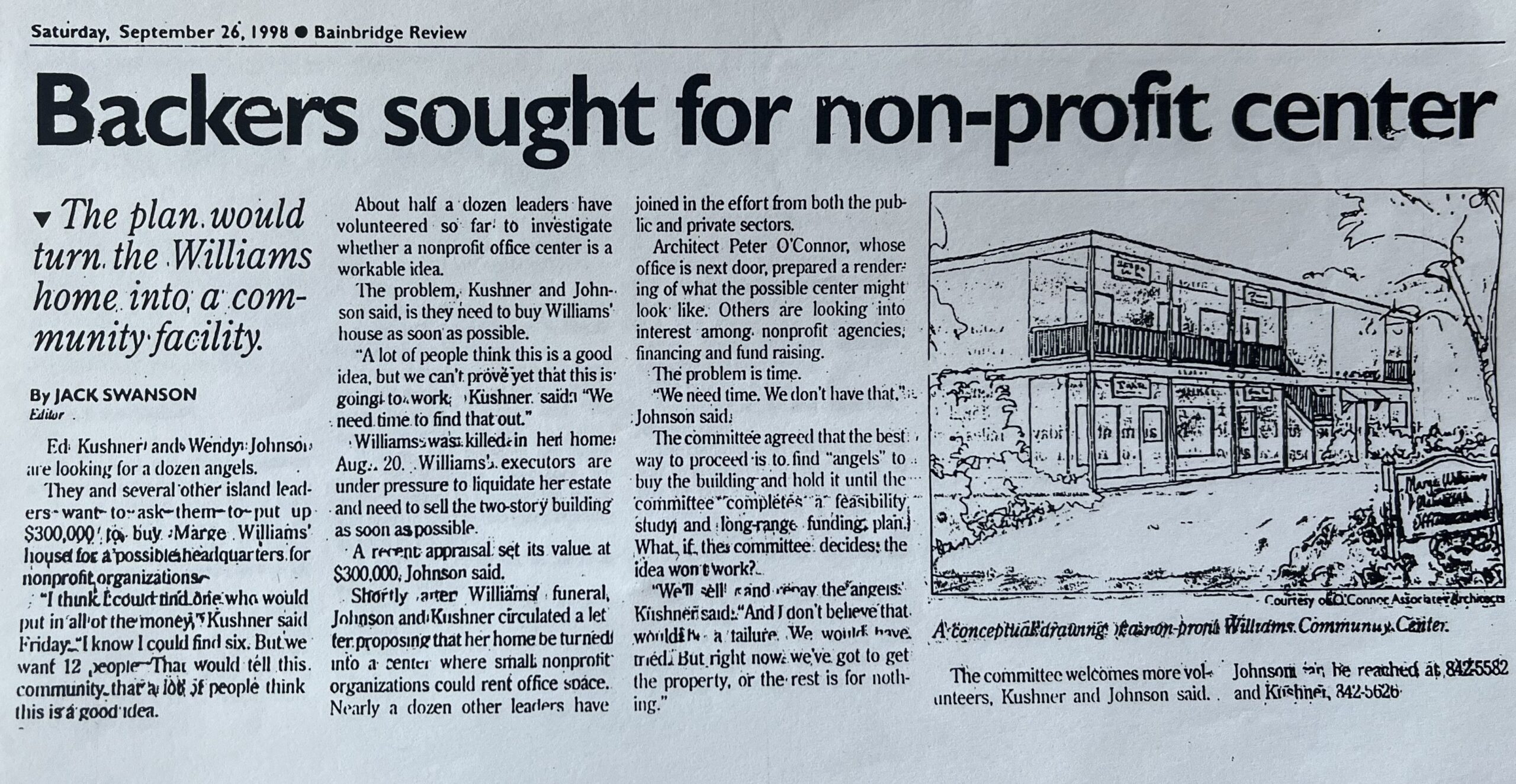
Now, Kushner used his cachet as community leader to find financial backers. Soon he had rounded up 13 angels – individuals, families and one corporation – who put up $300,000 in private money, to be paid back at an indefinite future date, interest-free.
That loan allowed the purchase of the building from the Williams estate in December 1998.
“Early on, a couple of people said, ‘Just bulldoze the damn thing and make a park out of it,’” Kushner said. “We didn’t think that was a significant enough response by the community. We wanted a memorial that was living, and useful to the community.”
The first half of 1999 was spent organizing a board of directors; the group received sanction as a non-profit in July of that year.
That left them with a building and a sizeable debt, but little else save faith.
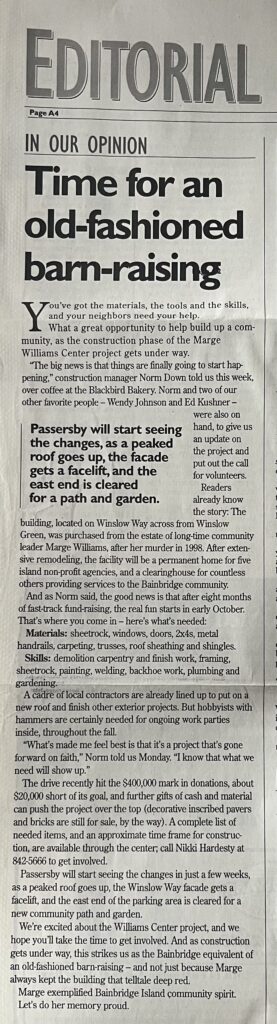
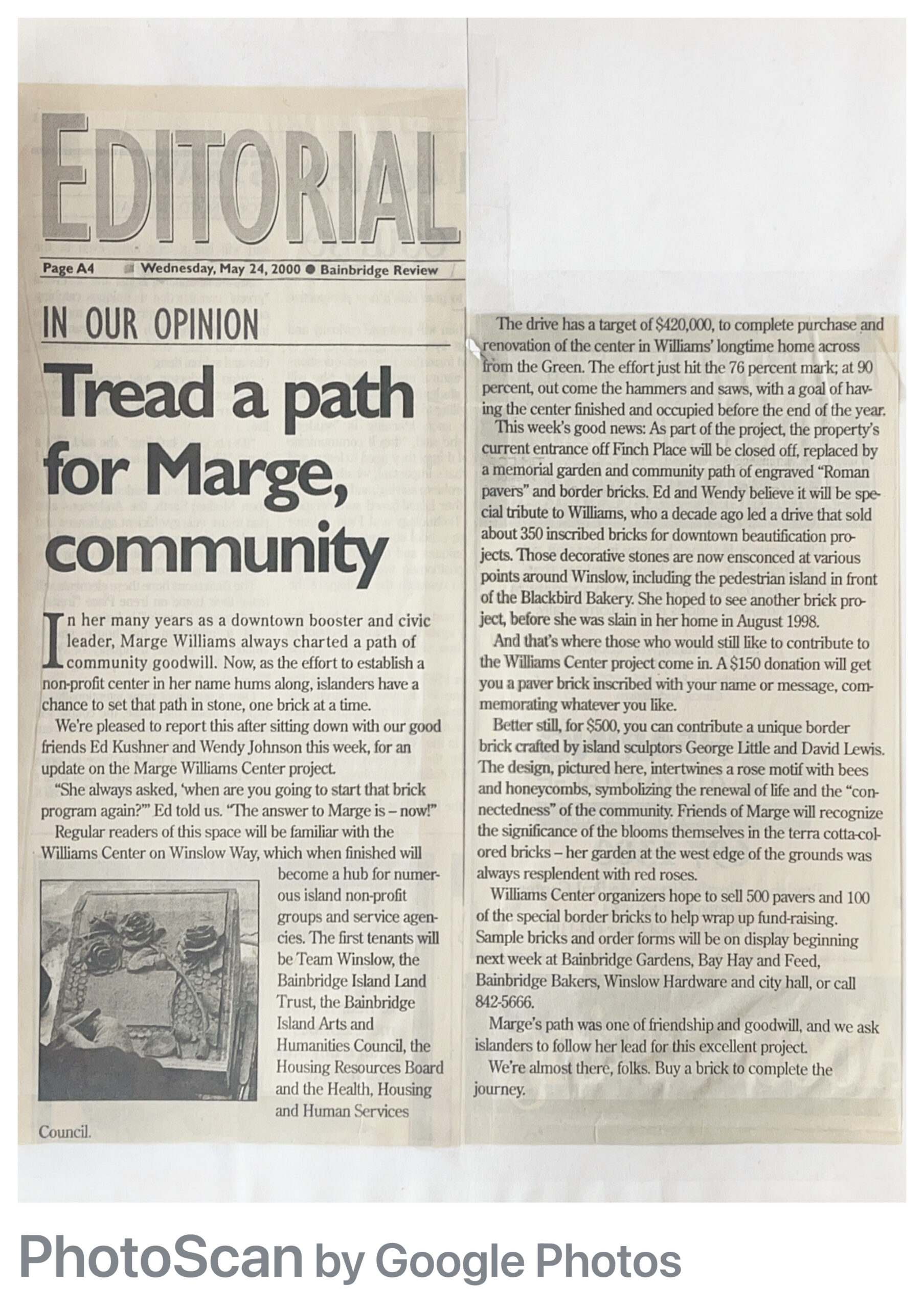
First steps at fundraising went nowhere. Then consultant Gordon Imlay stepped in pro bono, organizing an ambitious four-month drive to raise $420,000 – all private money – to cover purchase and refurbishing of the building. And while the board planned to drum up cash, labor and materials, Johnson also saw the opportunity to revive a long-dormant “buy a brick” program that had been a favorite cause of Williams a decade earlier.
The drive was launched in January 2000 and met with success. Even when Kushner suffered health problems in the middle of the drive, the organization proved solid – Carruthers was there to take his place as board chair.
“Everywhere we went,” Kushner said, “people asked, ‘what can we do?’ rather than, ‘why are you here again?’”
Not everyone they approached had known Marge Williams personally, but they did connect with the idea that island nonprofits needed a home, and that “this was a good place for it to be.”
Construction
Running a parallel track was Norm Down, who had been part of that street-corner conversation with Kushner five years earlier.
With development credits that include marinas and museums, Down was recruited as construction manager, a job that at its peak would fully consume four months of his life.
“I said, ‘If you raise the money, I’ll build it,’” Down recalled this week. “Then he went and raised the money.”
Down was given charge of the two-story building across from Winslow Green, an aging affair with some 2,000 square feet of floor space.
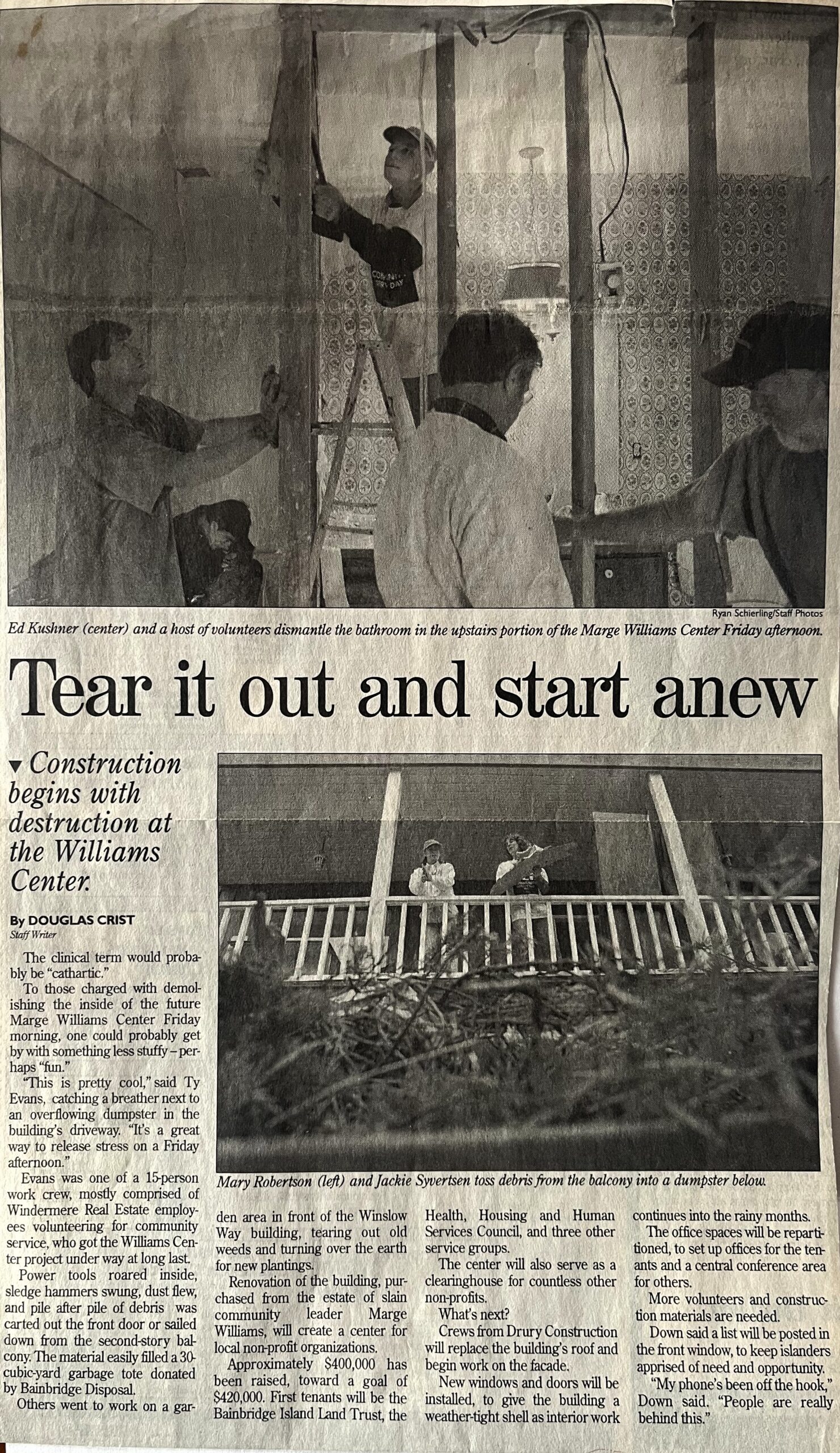
On the surface, the building was in poor shape. Upstairs, material had been removed in cleaning up the crime scene; the ground floor, meanwhile, was run down after a decade of abuse by Williams’ tenants, the local newspaper.
But structurally, it was solid. Volunteers ripping out old sheetrock laid bare a robust frame – high-quality lumber without a hint of rot, save for a corner of the front deck.
“The framing materials today would be used for cabinetry, not framing,” Down said.
And anyway, Down’s plans transcended the building’s present condition. Three architects were brought in: Karen Lawson for the interior spaces, Sean Parker for improvements to the facade, and Bart Berg for landscaping.
The building was apportioned for 60 percent office space, 40 percent common areas – including a foyer, conference room and kitchenettes to ensure plenty of interaction by tenants.
A peaked roof was added, and the facade shored up with new beams.
A sluggish permitting process – it took eight weeks for the application to clear City Hall – stalled work until fall of last year. But in October, construction went into full swing.
Down put his own business on hold, putting in 60-hour weeks at the Williams site.
He shepherded contractors from 7 a.m. to 3 p.m., then electrician Ron Lubovich would show up, and he and Down would install wiring until 10 p.m. They also worked weekends.
A spring move-in date loomed, as the soon-to-be tenant organizations had already given notice at their various locations. And the delays getting started meant that the schedule was squeezed at both ends.
Down credited a Drury Construction crew with speed and efficiency in the heaviest part of the work. But as construction went on, others stepped forward to take advantage of opportunities as well.
An outside door was added at the east end of the building, and an elaborate deck was then fashioned by woodworker Armistead Coleman.
Garnie Quitslund designed and built cabinetry for the kitchenettes and foyer, including mailboxes for agencies that won’t be actual tenants of the building. Other volunteers – community groups, individuals, neighbors – turned up on weekends to offer their own contributions of labor and skill, helping with construction or working on the grounds.
“That’s how this project was – if somebody showed an interest in something, turn them loose,” Down said. “It’s kind of like a quilt in that respect. It doesn’t reflect any one architect’s vision or one person’s vision. It doesn’t look like it, but this was done on a bare-bones budget. Any nicety you see was donated.”
Down has a saying: The first half of the project takes 90 percent of the time, while the second half takes the other 90 percent of the time. And, he says, that was certainly true of this building.
But with palpable certainty throughout the late winter and early spring months, in went the trim and the fixtures; every week revealed new details, more steps taken along the path to completion.
This week, most of the remaining tasks were in the hands of others. But even as he looked forward to resuming his own business, Down took evident pride in the project and his part in it.
“I think everybody should be involved in something that will outlive them, and whatever the cost is, just do it,” he said. “I think this building will be active and full long after I’m gone.”
Success
With barely 24 hours before the formal dedication, Wendy Johnson paced back and forth on the community path outside the Marge Williams Center.
Scanning the engraved pavers, she tried to reconcile a master list of orders against what is actually on the ground.
“I guess I’ve become already intimately acquainted with this path, and what’s on it,” she said. “It’s just what I was hoping for here.”
In fact, she sold twice as many bricks as planned. Some have yet to arrive, amongst other details that won’t be in place before the grand opening.
Even Friday afternoon, a cadre of volunteer landscapers were putting in last-minute plantings. But the building is essentially finished and ready for use. The Marge Williams Center is open.
“My initial conception of what we could accomplish was new paint on the walls, new carpet on the floor, and a roof that didn’t leak,” Kushner said. “All that’s been accomplished. But the project has exceeded anything I dreamed we could pull off.”
The success of the facility may be measured in many ways. The current buzzword is synergy – the synthesis of energy that comes through interaction, as the five service agencies are brought under one roof and new connections are made and resources shared.
Down believes other cities can use the facility as a model for nonprofit centers of their own. Too, there is a last round of fundraising to finish – construction costs have crept up to about $450,000. But of the original $300,000 put up to buy the building, Kushner said, the angels have agreed to simply forgive half that debt.
The identity of Marge’s angels themselves remains a mystery to all but a few. True, their names are there amongst the 300 or so small plaques on the donor board in the foyer – but to show that contributions big and small are of equal importance, the plaques were put up in completely random order.
Now, Kushner, Johnson, Carruthers and Down agree, it’s up to the community to write a new, positive and yet unimagined story for the building.
There is, in fact, but one remaining vestige of the tragedy from which it has been reclaimed – the door of the outside shed is still smeared with fingerprint dust, an overlooked reminder of an investigation long-since concluded, a crime prosecuted, a horror forgotten.
Looking at the door from the balcony, Down said: “I’ll paint it.”
####